



When conversations around sexual and reproductive health and rights take place, they often begin with access. Do these SRH services exist? Are the laws in place? Can people seek care without discrimination? Are policies protecting the rights of women, girls, and marginalised communities? These questions remain critical. Yet they tell only part of the story. Across Asia and the Pacific, many people continue to face barriers that extend far beyond the availability of services or legal protections. Gender, age, geography, disability, ethnicity, migration status, sexual orientation, gender identity, socioeconomic status, and humanitarian crises continue to shape whether people are able to exercise their rights safely, equitably, and with dignity. Even though, the rights may exist on paper, justice often remains out of reach.
This reality formed the basis of FIRE Chat No. 1, the inaugural session of Feminist Insights Regional Exchanges (FIRE), a new webinar series by IPPF East, Southeast Asia & Oceania Region that brings together advocates, healthcare providers, feminists, youth leaders, and community organisations to engage in bold conversations on sexual and reproductive health, rights, and justice. Held as part of International Women's Day 2026, the discussion challenged participants to rethink how we approach SRHR and asked a simple yet profound question:
when


For decades, advocacy efforts have focused on expanding legal protections, strengthening health systems, and improving access to services. These achievements have transformed countless lives and remain fundamental to advancing sexual and reproductive health and rights (SRHR). However, participants reflected an increasingly important reality: legal recognition alone does not guarantee meaningful access.
A health facility may exist, but distance, cost, discrimination, or fear may prevent someone from walking through its doors. Laws may protect against violence, yet survivors may remain unable to report abuse because systems are inaccessible or re-traumatizing. Policies may promise inclusion while continuing to overlook Indigenous communities, young people, LGBTQIA+ communities, sex workers, persons with disabilities, migrants, and others who experience multiple and intersecting forms of marginalisation.
Justice therefore cannot be measured solely by the existence of laws or services. Justice asks different questions such as “Who is still excluded? Who is believed? Who has the power to make decisions about their own body? Who feels safe enough to seek care? And whose experiences continue to be absent from the policies designed to protect them?”
Transformative justice challenges us to look beyond institutional responses and towards the structural inequalities that continue to shape health outcomes and lived experiences across the region. Justice requires transforming systems and not only expanding services.
Throughout the discussion, speakers emphasized that justice cannot be understood as a single intervention or policy reform. It requires transforming the systems that determine who can exercise their rights and under what conditions. Participants explored how intersecting identities influence every stage of a person's journey through healthcare, legal systems, education, and community spaces. For many communities, barriers rarely exist in isolation. They overlap and reinforce one another, creating layers of exclusion that cannot be addressed through one-dimensional solutions.
This requires moving beyond viewing justice solely as legal accountability. Justice also means access to accurate and evidence-based information. It means legal recognition of identity. It means survivor-centred responses to violence. It means comprehensive sexuality education that enables informed decision-making. It means ensuring that those most affected are not simply consulted but actively shape policies, programmes, and advocacy efforts.
Ultimately, justice asks us to move beyond asking whether systems exist and towards asking whether those systems work for everyone.
The conversation also recognised the wider context in which movements are operating today. Across many parts of the region, organisations continue to navigate shrinking civic space, organised backlash against gender equality, restrictions on comprehensive sexuality education, attacks on bodily autonomy, and increasing pressure on civil society organisations. These challenges are unfolding alongside humanitarian crises, climate emergencies, and widening inequalities that disproportionately affect women, girls, and marginalised communities.
In this context, solidarity becomes more than a principle. It becomes a strategy.
Tomoko Fukuda, Regional Director of IPPF ESEAOR, reflected on the importance of looking beyond immediate challenges and investing in collective futures.
"Access to justice is not just the right to a courtroom. It is the bridge between human rights and lived reality. Justice should be understood as transformative." Upala Devi, Regional Gender and Human Rights Technical Adviser, UNFPA Asia Pacific
"We want to look not just at what we are doing today, but also into the future, to strengthen our solidarity and move stronger together."
Her message resonated throughout the discussion. Progress depends not only on individual organisations, but on movements that learn together, challenge one another, and continue building collective power across borders and generations. This spirit also reflects the recently adopted IPPF Charter of Values, which commits the Federation to advancing dignity, equality, justice, pleasure, community, integrity, and resilience. These values remind us that justice is not an aspiration reserved for the future. It is a responsibility that must shape how we work today.
One of the strongest messages emerging from FIRE Chat No. 1 was the importance of creating spaces where complex issues can be discussed honestly. Too often, the conversations around SRHR are reduced to technical solutions or policy language. While these remain essential, they cannot replace dialogue that centres lived experiences, challenges assumptions, and acknowledges the realities communities face every day. FIRE Chat was created to hold these conversations. By bringing together practitioners, advocates, healthcare providers, researchers, and young people from across Asia and the Pacific, the series aims to strengthen regional learning while fostering the collective reflection needed to advance gender and reproductive justice. These conversations are not about arriving at simple answers. They are about asking better questions, sharing experiences across contexts, and building stronger movements equipped to respond to an increasingly complex world.
The conversations will continue to explore the challenges shaping SRHR across Asia and the Pacific while creating opportunities for collaboration, shared learning, and collective action. As movements continue to defend bodily autonomy and human rights in increasingly contested environments, one message remains clear. Advancing sexual and reproductive health and rights is not only about expanding access. It is about transforming the systems that determine whose rights are realised, whose voices are heard, and whose dignity is recognised. Justice is not simply the outcome we seek, it is the path we choose to take together.
About FIRE Chats
FIRE (Feminist Insights Regional Exchanges) is IPPF ESEAOR's regional webinar series that brings together advocates, healthcare providers, researchers, youth leaders, and community organisations for bold conversations on sexual and reproductive health, rights, and justice across Asia and the Pacific. Each session creates space for regional learning, critical reflection, and collective action on the issues shaping our movements today.
If you would like to be part of these conversations, please contact Natassha Kaur, Regional Communications, Voice, & Media, Advisor IPPF ESEAOR on [email protected]
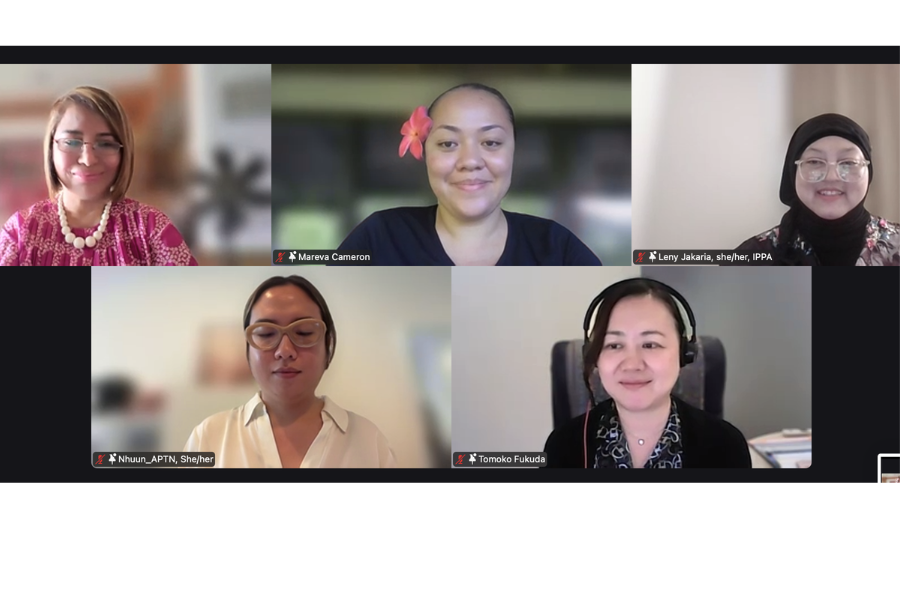
FIRE CHAT #1
IPPF ESEAOR