



This Pride Month, the International Planned Parenthood Federation East and South East Asia and Oceania Region (IPPF ESEAOR) proudly stands in full, resounding solidarity with the powerful and resilient lesbian, gay, bisexual, transgender, queer/ questioning, intersex, asexual and other diverse sexual orientations or gender identities (LGBTQIA+) communities across East Asia, Southeast Asia, and the Pacific. As allies and members of this community, we join in celebrating not only visibility, diversity, and love, but also the enduring strength of collective resistance in the face of stigma, discrimination, and the ongoing demonisation of people with diverse sexual orientations, gender identities and expressions, and sex characteristics (SOGIESC).
Pride is a celebration and a living practice of resistance and defiance. We honour the roots of this global movement, particularly the pivotal moment of uprising in the West marked by the Stonewall Riots in New York in 1969. It was a monumental act of rebellion led by trans women of colour and queer people pushed to the margins. While Western-led, this movement catalysed a global wave of organising that continues to inspire and empower LGBTQIA+ activism to this day.
Within the growing and diverse LGBTQIA+ movements, we recognise many victories: decriminalisation, legal gender recognition, and marriage equality, particularly in Western nations. We also recognise the support within the movement as it built momentum globally, enabling LGBTQIA+ organisations in the Global South to strengthen advocacy, leadership, and sustainability through capacity building and financial support.
when
region
East and South East Asia and Oceania
But as we celebrate our communities’ enduring strength, Pride Month is also a time of reflection.


We hold space to reckon with challenges and the new, insidious forms of stigma and exclusion that continue to shape our lives. As our visibility increases, so too do the coordinated attacks on our existence, often disguised as moral panic, digital disinformation, and repressive policies.
We must also tell the fuller story. Much of the harm that people with diverse SOGIESC continue to endure today such as criminalization, pathologization, and social alienation has its roots in colonial conquest. Colonizers exported rigid gender binaries, outlawed same-sex relationships, and imposed Judeo-Christian moral frameworks that suppressed and erased pre-colonial understandings of gender and sexuality. In many parts of our region, this legacy remains entrenched in law and custom.
Before the arrival of colonial powers, gender-diverse individuals and queer people held respected roles in our societies as healers, mediums, anointers, spiritual leaders, and advisors to kings and queens.
We recognize the importance of history and reclaiming the narratives that colonialism tried to erase. Tracing the roots of Pride in Asia and the Pacific through a decolonial lens is essential to achieving true liberation for people with diverse SOGIESC.
In this region, Pride in Asia and the Pacific is not a Western import. Pride is also more than resistance to colonial and post-colonial oppression. It is an ancient memory and a celebration of our enduring presence, strength, and community. It is a reassertion of our rightful place in the cultural and spiritual fabric of our societies.
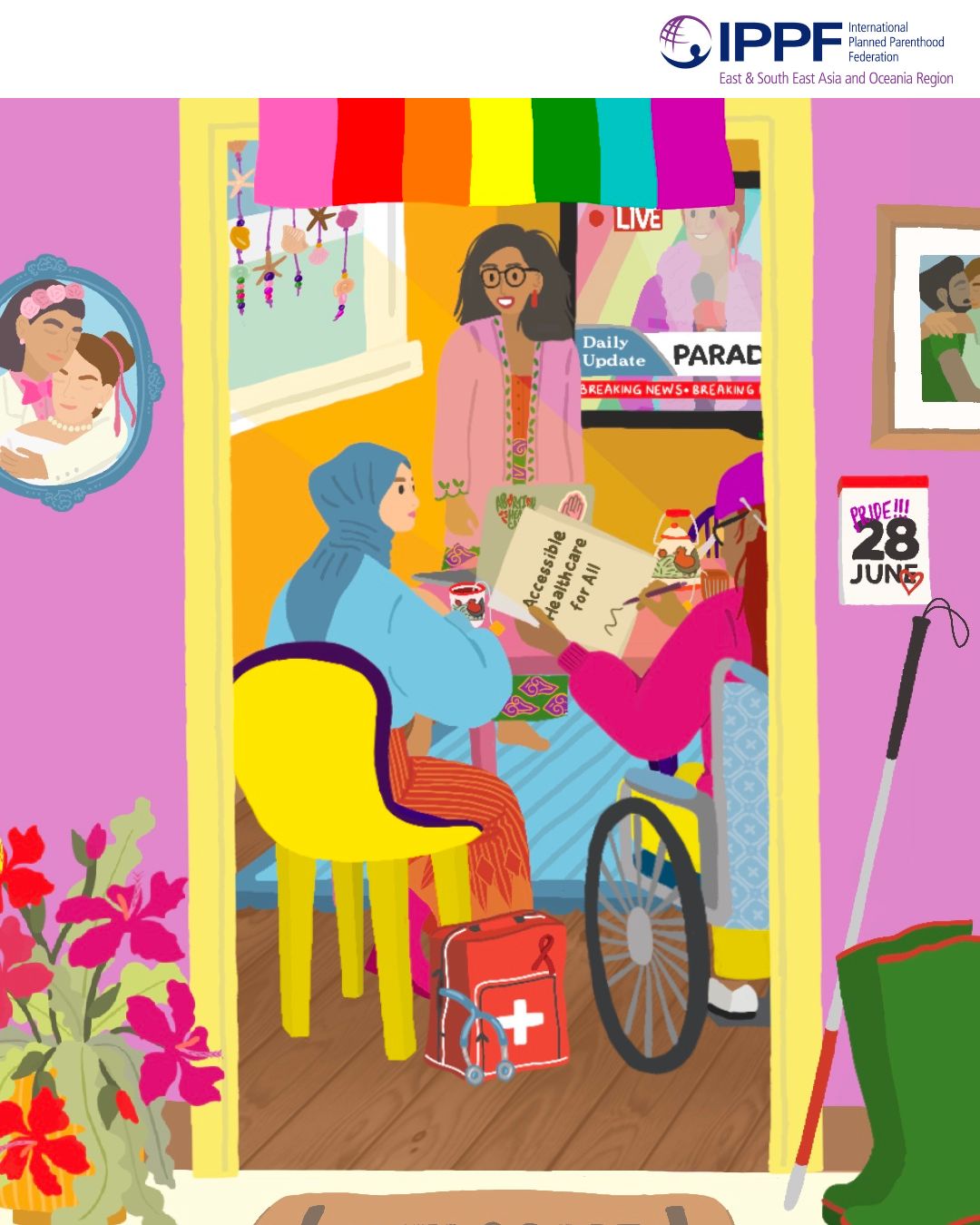
Inclusive and accessible SRHR services for all
Nubaila SafritiAt IPPF, we believe that the sexual and reproductive health and rights (SRHR) of people with diverse SOGIESC are not “special” rights. They are human rights. They are equal, and they must be treated as such.
From its inception, IPPF has worked to champion these rights, ensuring their integration into health systems, including access to quality and non-discriminatory sexual and reproductive health (SRH) services and information in both stable and humanitarian settings, and holding institutions accountable for discrimination.
This commitment is woven into IPPF’s new Strategic Framework, which boldly pivots to mainstream our work with people with diverse SOGIESC. IPPF is embedding inclusive SRHR by challenging gender inequality, advancing bodily autonomy, and expanding access to person-centred care, many of which are led by communities themselves.
We deepen our partnerships with justice movements, including LGBTQIA+ leaders, to turn this vision into action. Just last year, IPPF ESEAOR co-hosted the South-South Dialogue in Bangkok, bringing together 17 young LGBTQIA+ leaders from Asia and the Pacific to co-create intersectional advocacy. We supported community-led trans health through FPOP Iloilo’s clinic in the Philippines and strengthened partnerships in Indonesia and Malaysia to build safety and resilience. At ILGA Asia 2025, we backed community-led events focused on rights and climate justice.
At IPPF, we believe that the sexual and reproductive health and rights (SRHR) of people with diverse SOGIESC are not “special” rights. They are human rights. They are equal, and they must be treated as such.
We stand in humanitarian solidarity with LGBTQIA+ communities across the region who continue to navigate the intersecting crises of conflict, displacement, and climate change, from political instability in Myanmar to the growing impacts of environmental disasters across the Pacific. In every crisis, the rights, dignity, and safety of people with diverse SOGIESC must be protected and upheld.
As we move into 2025, IPPF ESEAOR will continue championing community leadership, resisting rollbacks on rights, and amplifying silenced voices—especially youth, trans people, queer women, intersex individuals, indigenous leaders, and rural LGBTQIA+ communities.
Finally, we affirm that this journey cannot be walked alone. In a time of increasing global regression and sophisticated anti-rights campaigns, our only path forward is through cross-movement solidarity. The struggle for LGBTQIA+ rights is inherently linked with the fight for racial justice, economic equity, environmental sustainability, disability rights, and bodily autonomy for all.
Together, we are stronger. And we are unstoppable.
With Pride, With Power, With You. IPPF ESEAOR celebrates you.
Happy Pride Month 2025.
