



To mark Menstrual Hygiene Day 2026, IPPF ESEAOR hosted the second edition of its FIRE Chat Series, bringing together young advocates from across Asia and the Pacific to explore a simple yet profound question: What does menstrual dignity really mean?
Featuring youth leaders from Vietnam, Mongolia, Tonga, and Pakistan, the discussion challenged participants to look beyond menstrual hygiene products and awareness campaigns. The conversation centred on dignity, bodily autonomy, participation, inclusion, and the structural barriers that continue to shape menstrual experiences across the region.
Although each speaker came from a different cultural and political context, one message remained constant: menstruation is a universal biological experience, yet stigma continues to deny millions of people the right to experience it with dignity.
when
Opening the discussion, Jenny Thu Nga Doan, Chairperson of the Youth SRHR Network in East, Southeast Asia and the Pacific (YSNAP) and youth representative, Vietnam Family Planning Association (VINAFPA) shared a deeply personal story about growing up believing that menstruation made her "unclean". She recalled being discouraged from visiting pagodas during Lunar New Year while menstruating because cultural beliefs passed through generations.
"Menstrual dignity is about whether girls can participate fully in their own culture and family life." - Jenny Thu Nga Doan


She further reflected on how shame begins early. Girls hide sanitary pads, whisper about periods, and often feel unable to even ask their mothers for help.
She explains, “how that silence becomes much more than embarrassment - it becomes a barrier to information, healthcare, and confidence”.
Later in the discussion, Jenny spoke about how these same taboos become even more dangerous during humanitarian emergencies. Drawing on Vietnam's annual flooding, she explained that menstrual health often disappears from disaster response because it was never part of everyday conversations to begin with.
For Rose Sarnai Gan-Orgil, YSNAP member and youth representative, Mongolia Family Welfare Association (MFWA), menstrual dignity begins with education and with recognising who is left out of those conversations.
Rose described how boys are frequently excluded from discussions about menstruation, allowing myths, teasing, and misinformation to flourish. Rather than separating boys and girls, her organisation brings them together for menstrual health sessions.
"Menstruation is not just a girls' issue. It is a human issue that everyone should understand." - Rose Sarnai Gan-Orgil
She also highlighted another group that is routinely overlooked: adolescents with disabilities. While many programmes now speak about menstrual health, accessibility is often forgotten. Simple adjustments such as clearer language, more time to process information, and creating welcoming spaces for questions can benefit everyone.
Representing Youth OCEANS and the youth network of the Tonga Family Health Association (TFHA), Seneti Fatongai reflected on growing up in a context where discussions about menstruation remain heavily shaped by culture and faith. She described schools where menstrual products are unavailable, teachers dismiss period pain, and girls continue to face teasing from classmates. For Senneti, the solution is not to reject culture, but to engage with it differently.
"Comprehensive Sexuality Education adds to culture—it does not remove it." - Seneti Fatongai
She argued that Comprehensive Sexuality Education (CSE) creates opportunities for young people, families, teachers, and communities to discuss menstruation openly while respecting cultural contexts. Rather than challenging culture itself, CSE helps build cultures where young people feel safe asking questions, seeking support, and understanding their bodies.
One of the most powerful conversations of the session came from Zai, representing the Trans Masc Alliance, Pakistan, who challenged assumptions about who is included in menstrual health conversations. Drawing from their own experience as a non-binary person living with PMOS (Polyendocrine Metabolic Ovarian Syndrome), Zai explained how menstrual campaigns that refer only to "women and girls" unintentionally erase the experiences of trans masculine and non-binary people who menstruate.
"The first step towards inclusion is changing our language, from 'women and girls' to 'people who menstruate.'" - Zai
Language, they argued, shapes who feels recognised and who feels invisible. But inclusion must also extend beyond words. Menstrual products placed only in women's toilets, for example, become inaccessible to many trans men and gender-diverse people who menstruate. Throughout the discussion, Zai emphasised that recognising diverse experiences does not diminish anyone else's. Later, responding to questions about sustainable menstrual products, Zai encouraged wider access to reusable options such as menstrual cups while acknowledging that affordability, comfort, dysphoria, and local contexts all influence personal choices.
The discussion was enriched by participants who brought additional regional perspectives into the conversation. Nandini Mazumder, Assistant Coordinator of the Asia Safe Abortion Partnership (ASAP) highlighted how menstrual dignity is also shaped by politics and power. She pointed to restrictions on menstrual products under Myanmar's military regime and reminded participants that menstruation remains neglected not only socially but scientifically.
"We need to hold those in power accountable, rather than placing the burden of change solely on individuals." - Nandini
Audience members also discussed inadequate sanitation facilities in Pacific schools, menstrual waste management, humanitarian access, and persistent myths that continue to reinforce shame across generations. One participant, a trans man undergoing hormone replacement therapy, shared the emotional experience of menstruating again after two years without a period. Thus, highlighting the unique challenges faced by many transgender people navigating menstruation within unsupportive family environments. These stories reinforced that menstrual dignity must include everyone, regardless of gender identity, disability, geography, or circumstances.
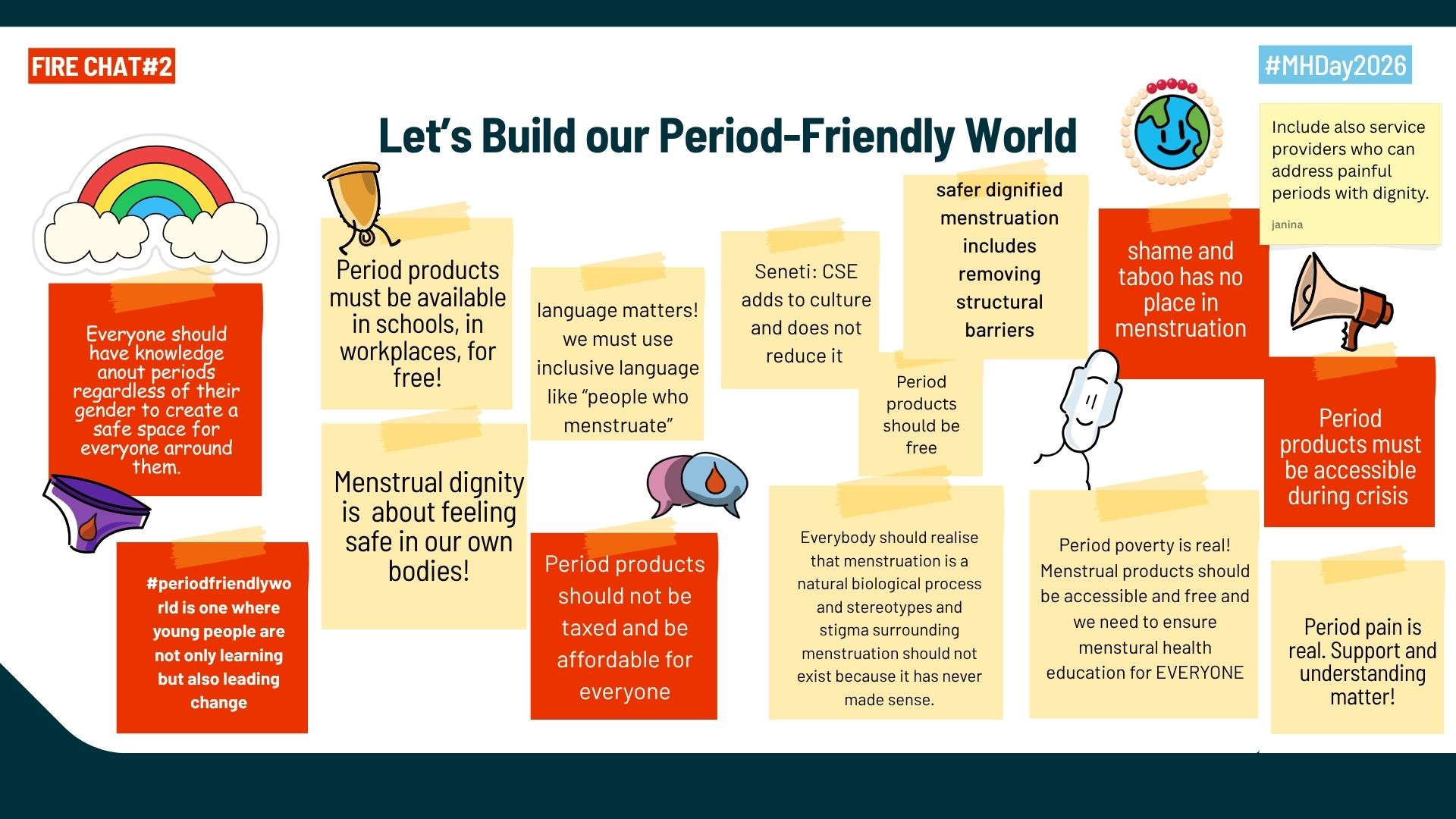
Period-friendly Wall
IPPF ESEAORAs the session drew to a close, participants were invited to imagine what a truly period-friendly world would look like.
Across the discussion and the collaborative Canva board, several priorities emerged:
-
Affordable and tax-free menstrual products.
-
Comprehensive Sexuality Education that is inclusive, accessible, and culturally responsive.
-
Menstrual products available in schools, workplaces, public institutions, and humanitarian settings.
-
Inclusive language that recognises all people who menstruate.
-
Greater involvement of families, boys, men, teachers, healthcare workers, and communities.
-
Policies that recognise menstrual health as a matter of dignity, rights, and public participation.
"Wherever we are and whoever we are, our problems around menstruation are fundamentally the same." - Zai
Closing the conversation, participants agreed that menstrual dignity is about far more than access to menstrual products. It is about creating societies where every person who menstruates can access information, healthcare, education, public spaces, and community life without shame, exclusion, or discrimination.
As the FIRE Chat demonstrated, reclaiming menstrual dignity requires collective action—from communities and schools to governments, humanitarian actors, and health systems. And most importantly, it requires listening to the lived experiences of young people who continue to lead this movement across Asia and the Pacific.
About FIRE Chats
FIRE (Feminist Insights Regional Exchanges) is IPPF ESEAOR's regional webinar series that brings together advocates, healthcare providers, researchers, youth leaders, and community organisations for bold conversations on sexual and reproductive health, rights, and justice across Asia and the Pacific. Each session creates space for regional learning, critical reflection, and collective action on the issues shaping our movements today.
If you would like to be part of these conversations, please contact Natassha Kaur, Regional Communications, Voice, & Media, Advisor IPPF ESEAOR on [email protected]
